


The Marketing Gap You Can't See
Your competitor's marketing looks like magic. They post everywhere. They respond to every comment. Their emails feel personal even though you know they have the same three-person team you do.
Here's what's actually happening: they stopped doing marketing the way you're doing it about 18 months ago.
I've been tracking this shift across dozens of small businesses, and the pattern is unmistakable. The companies pulling ahead aren't working harder. They're not even working smarter in the traditional sense. They've quietly automated the 60% of marketing work that used to eat their entire week.
The data backs this up. According to HubSpot's research, 74% of marketers now use AI in their roles—up from just 21% in 2023. That's not a trend. That's a complete restructuring of how marketing gets done.
But here's what I'll show you in a moment: most small businesses are using AI marketing tools wrong. They're chasing content generation when the real money is hiding somewhere else entirely.
What Is AI Marketing Automation (And Why Should You Care)?
Traditional marketing automation follows rigid rules. If someone opens an email, send follow-up B. If they click a link, add them to list C. You've probably set up flows like this yourself.
AI marketing automation is different. Instead of following your pre-written rules, it analyzes patterns in your data, predicts what's likely to work, and adjusts campaigns on the fly. The software learns which subject lines your audience responds to, which send times get opens, which offers convert—and it keeps optimizing without you touching anything.
Here's the practical difference: Traditional automation executes your playbook. AI automation writes a better playbook while you sleep.
The numbers tell the story. Companies using AI marketing automation see 42% more content output and 27% higher conversion rates, according to HubSpot's State of AI Marketing research. That's not marginal improvement—that's the difference between breaking even and actually growing.
The Real ROI: Where AI Marketing Tools Pay Off
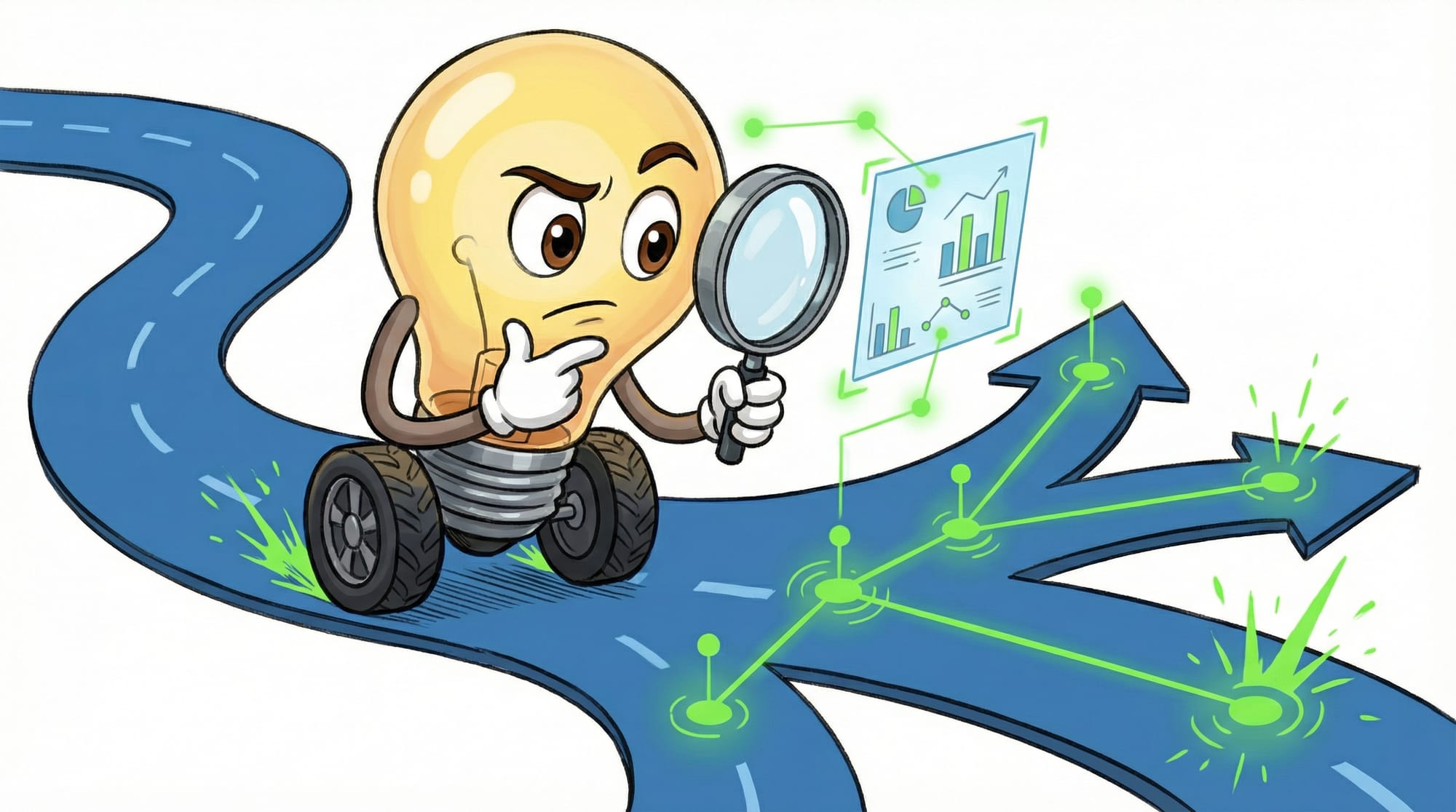
Everyone talks about AI writing blog posts and generating images. Those tools exist and they're fine. But if you want to know where the serious ROI hides in AI tools for marketing, it's in three less glamorous areas.
Analytics and Reporting
Tasks that used to take days—campaign reporting, performance monitoring, figuring out which channels actually drove that sale—can now be automated and completed in minutes. By 2026, 75% of top-performing B2B marketing teams are using AI-powered predictive analytics to drive strategy.
This isn't about pretty dashboards. It's about knowing which of your marketing dollars actually generated revenue, and knowing it fast enough to shift budget mid-campaign.
Campaign Coordination
The most advanced AI marketing tools don't just help with individual tasks. They actively coordinate campaigns across channels, using your customer data to optimize timing, messaging, and targeting in real-time.
Marketing automation software now handles more than sending emails on a schedule. It connects intake requests, creative production, approvals, and reporting into a single flow. The busywork that used to fragment your team's attention? It runs in the background.
Personalization at Scale
Here's something traditional automation simply cannot do: deliver unique, context-aware experiences to every customer across all touchpoints. AI enables hyper-personalization—the kind where your email actually references what someone browsed last week, your ad creative adjusts based on purchase history, and your website shows different offers to different segments automatically.
This used to require a team of five and custom development. Now it's built into tools that cost a few hundred dollars a month.
The Part Everyone Gets Wrong About AI Marketing
Remember that counterintuitive pattern I mentioned? Here it is.
While generative AI for content gets all the headlines, the most significant ROI comes from AI's application in analytics, reporting, attribution, and predictive modeling. In 2026, content is no longer the bottleneck. The real challenge is turning user data into coordinated campaigns that actually drive engagement and revenue.
Most small businesses I talk to are using ChatGPT to write social posts while ignoring the tools that would tell them which posts actually generate leads. They're generating more content into the void instead of understanding what's already working.
Without unified data, even the best AI tools create silos. Your email tool doesn't know what your ad platform knows. Your CRM doesn't sync with your website analytics. The AI can only be as smart as the data you feed it.
If you're building an AI strategy for your business, start with the data infrastructure, not the flashy features.
How Do You Choose AI Marketing Tools That Actually Work?

I've watched too many businesses buy expensive tools that gather dust. Here's the framework that actually works for small business selection.
The 5-Question Framework
- Does it connect to what you already use? The best AI tool in the world is useless if it can't pull data from your existing email platform, CRM, and ad accounts. Check integrations before features.
- What specific problem does it solve? 'AI-powered' means nothing. Does it reduce time spent on reporting? Improve ad targeting? Automate follow-ups? If you can't name the specific pain it addresses, you don't need it.
- Can you afford it at scale? That $50/month starter plan looks great until you hit the usage limits. Calculate what you'll actually pay when you're using it daily across your real customer list.
- How long until you see results? Some tools pay off in week one (reporting automation). Others take months to show ROI (predictive analytics that needs training data). Match the tool to your patience and cash flow.
- What happens to your data if you leave? If all your customer insights live inside a tool you don't own, you're building on rented land. Check data export options before you commit.
This connects directly to what I covered in my piece on AI tools that actually drive revenue—the tools that work are the ones that solve real operational problems, not the ones with the best marketing.
What Breaks When You Add AI to Your Marketing?
I'd be lying if I told you this was all upside. Here's what actually goes wrong.
- **Data quality disasters.** AI amplifies whatever you feed it. If your CRM is full of duplicate contacts, outdated emails, and incomplete records, AI will confidently send the wrong message to the wrong person—faster than ever before.
- **The 'set and forget' trap.** AI marketing tools need monitoring, especially in the first 90 days. I've seen businesses let automated campaigns run for months without checking performance, only to discover the AI optimized for the wrong goal.
- **Integration fragility.** These tools connect through APIs, and APIs break. A single authentication failure can stop your entire automation flow. Budget time for maintenance.
- **Content that sounds like everyone else's.** If you let AI write all your copy without human editing, you'll sound exactly like your competitors who are doing the same thing. The efficiency gain disappears when nobody can tell you apart.
- **Vendor lock-in creep.** The more workflows you build inside a platform, the harder it becomes to leave. This isn't a reason to avoid AI tools—it's a reason to choose carefully upfront.
Your Monday Morning AI Marketing Checklist
Here's exactly what to do this week if you want to start using AI marketing automation without wasting money or time.
- **Audit your current data.** Open your CRM and email platform. Count how many contacts have incomplete records (missing email, no company, no last activity date). If more than 20% are incomplete, clean your data before buying any AI tools.
- **Identify your biggest time sink.** Track where you spend marketing hours this week. Is it reporting? Content creation? Lead follow-up? The area eating the most time is where AI will have the fastest ROI.
- **Calculate your real costs.** If you're spending 10 hours/week on campaign reporting at an effective rate of $50/hour, that's $2,000/month. A reporting automation tool at $200/month pays for itself immediately.
- **Pick one tool, not five.** Start with the single highest-impact area. If your biggest pain is not knowing what's working, start with analytics. If it's lead follow-up, start with automation sequences. Don't try to transform everything at once.
- **Set a 30-day checkpoint.** Whatever tool you choose, schedule a calendar reminder to evaluate after 30 days. Is it actually saving time? Are the results accurate? If not, cut it before you build dependencies.
- **Budget $100-300/month to start.** Most capable AI marketing tools for small business fall in this range. If you're being quoted $500+/month before you've proven the use case, you're probably overpaying.
What Does Success Look Like?
You'll know your AI marketing automation is working when you see these signs.
- Your weekly reporting takes minutes instead of hours
- You can trace specific revenue back to specific campaigns (attribution actually works)
- Your team spends less time on data entry and more time on creative work
- Personalized campaigns run automatically based on customer behavior—without manual setup each time
- You spot underperforming campaigns within days, not months
The goal isn't to automate everything. It's to automate the parts that don't require human judgment, so the humans on your team can focus on work that actually moves the needle.
Frequently Asked Questions
How much does AI marketing automation cost for small business?
Most effective AI marketing tools run $100-300/month for small business use. Enterprise-grade platforms cost more, but you probably don't need them. Start with a single tool that solves your biggest pain point, prove the ROI, then expand.
Can AI marketing automation work without a big email list?
Yes, but the returns scale with your data. With a list of 500, you'll see some automation benefits. With 5,000+, AI can identify meaningful patterns and optimize more effectively. Start building your list while you implement the tools.
What's the difference between AI marketing automation and regular marketing automation?
Traditional automation follows rules you write—if this, then that. AI automation learns from your data, predicts outcomes, and optimizes campaigns automatically. The difference is adaptation: AI gets better over time without you reprogramming it.
Do I need technical skills to use AI marketing tools?
Most modern AI marketing tools are designed for marketers, not developers. If you can use email software and spreadsheets, you can use these tools. The learning curve is usually a few hours, not weeks.
Which AI marketing task should I automate first?
Start with whatever takes the most time and requires the least creativity. For most small businesses, that's reporting and analytics, or lead follow-up sequences. Content generation is tempting but usually delivers less ROI.


