


Here's a number that should make you pause: 42% of companies abandoned most of their AI initiatives in 2025. That's up from 17% in 2024. In one year, the abandonment rate more than doubled.
I've watched this pattern unfold across dozens of implementations. A company gets excited about AI. They pick a flashy use case. The demo looks amazing. Six months later, the project is quietly shelved.
The executives who greenlit it? They're not talking about it anymore. The team that built it? Already moved on. And the problem it was supposed to solve? Still there.
For a complete framework on getting started, see our AI Implementation Guide.
Why Do 75% of AI Projects Fail to Deliver ROI?
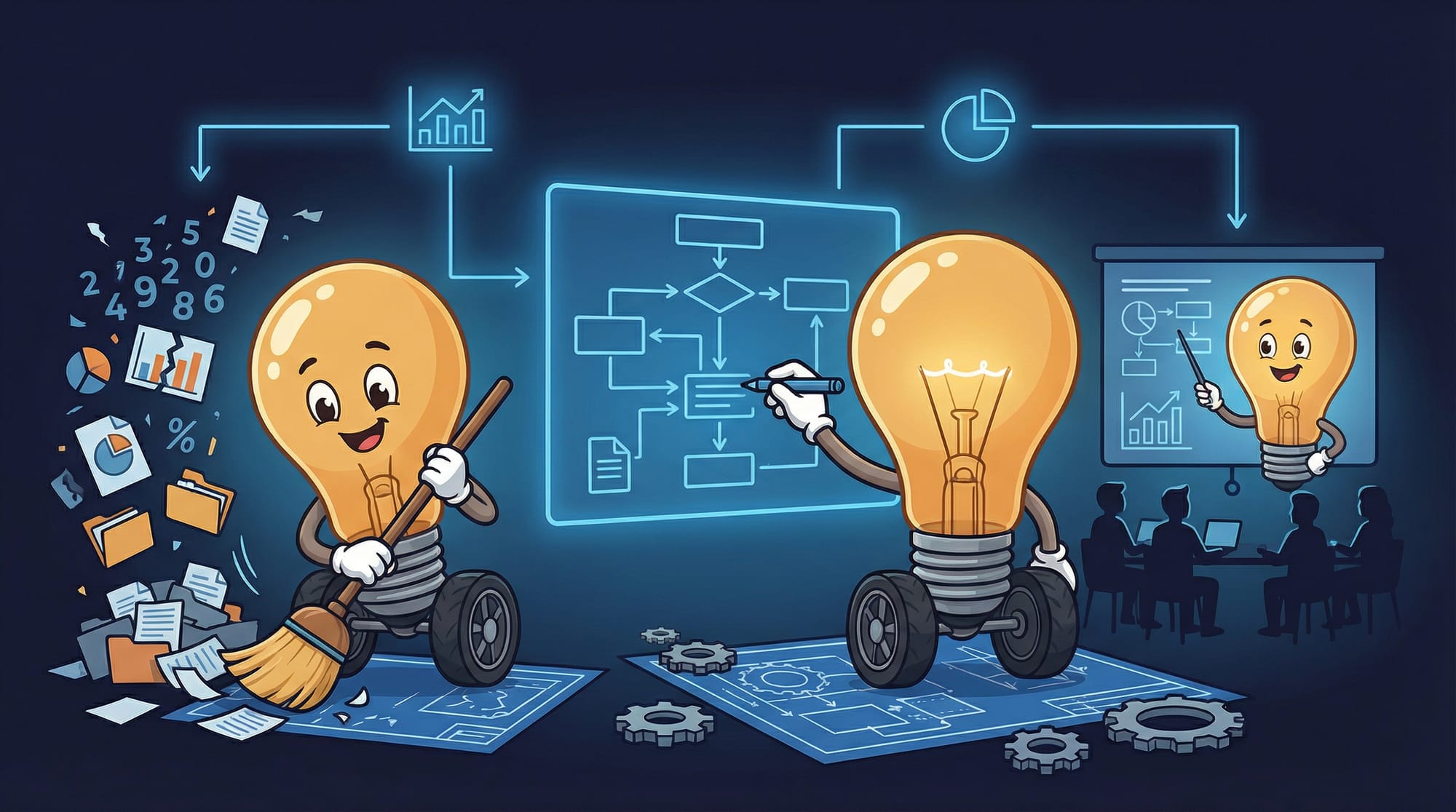
IBM surveyed 2,000 CEOs worldwide for their 2025 study. The findings are brutal. Only 25% of AI initiatives delivered the return on investment they expected over the past three years. Even worse? Just 16% managed to scale across their whole company.
That's not a technology problem. That's an organizational problem.
The RAND Corporation looked at this differently. They found over 80% of AI projects fail—which is twice the failure rate of non-AI technology projects. Same companies. Same budgets. Same teams. Twice the failure rate.
Why? Because AI projects are fundamentally different from traditional software. They're data-centric, not code-centric. Your CRM implementation failed when the code didn't work. Your AI implementation fails when the data doesn't exist, isn't clean, or doesn't represent reality.
MIT's research puts an even finer point on it: 95% of enterprise generative AI pilots fail to deliver measurable business value. Companies are spending $30-40 billion annually on AI. Most of it goes nowhere.
What Does the Graveyard of Failed AI Projects Look Like?
Scene one: A sales team gets an AI tool that's supposed to prioritize leads. The demo showed it predicting which prospects would close. Beautiful dashboards. Impressive accuracy numbers.
Scene two: Monday morning. The sales team opens the tool, glances at it, and goes back to calling the leads they were already going to call. Within three months, login rates drop to near zero.
Does that ring a bell?
The average organization scrapped 46% of AI proof-of-concepts before they reached production, according to S&P Global Market Intelligence. Nearly half of everything built never made it out of the lab.
Here's what I find fascinating. The technical teams usually delivered what was asked. The models worked. The accuracy was good. The dashboards were pretty. But nobody changed how they worked.
That insight comes from Harvard Business Review's analysis of failed AI initiatives. The technology works. The organization doesn't adapt. And 74% of CEOs are now worried they'll lose their jobs within two years if they don't prove AI is making money.
How Do You Avoid the "Cool AI" Trap?

Most AI pilots fail—not because the tech doesn't work—but because organizations chase "cool AI capabilities" instead of solving real, costly business problems. I've seen this play out so many times I can predict it.
Someone reads about ChatGPT. They think: "We should use AI for something." They pick a use case that sounds impressive in a board meeting. They build it. It works technically. Nobody uses it.
The few initiatives that succeed—that 5% to 25% depending on which study you trust—all share a pattern. They start with a problem that's already costing real money.
The Problem-First Framework
The pattern that emerged across multiple sources is simple but requires discipline:
- Start with a well-scoped problem. Not "improve customer service" but "reduce average resolution time for password reset requests from 4 hours to 15 minutes."
- Deploy fast. Weeks, not years. If your AI project requires a 30-day implementation roadmap before you see results, you're building the wrong thing.
- Let business users lead workflows under IT governance. The people who feel the pain should design the solution. IT keeps it secure and scalable.
- Measure ROI from day one. If you can't put a dollar figure on the problem before you start, you won't be able to prove value after.
Look at what actually works. Lumen Technologies projects $50 million in annual savings from AI tools that save their sales team an average of four hours per week. That's a boring use case. Time saved on routine tasks. But it's measurable. It's real. And it scales.
Air India's AI virtual assistant handles 97% of 4 million+ customer queries with full automation. That's not a sexy innovation story. That's a cost story. Millions in support costs avoided.
If you're exploring what AI agents can actually do for your business, I'd recommend checking out our AI agents and automation coverage—it's where we track what's working in production.
What Happens When AI Meets Monday Morning Reality?
Let me paint you a picture I've seen too many times.
Friday: The AI project launches. Everyone's excited. The demo was flawless. The CEO mentioned it in the all-hands.
Monday: First real users log in. The data looks different than the training data. Edge cases appear that nobody anticipated. The AI gives a confident wrong answer. Someone important sees it.
Tuesday: Trust is broken. The team scrambles to add guardrails. Users start routing around the AI. "Just in case."
Three months later: The project is technically still running. Usage is down 80%. Nobody wants to be the one to officially kill it.
The old logic was: build it right the first time. Spend months on requirements. Get every stakeholder to sign off. Launch when it's perfect.
Now that's broken. AI systems learn. They improve with feedback. But they can't get feedback if nobody uses them. And nobody uses them if the first experience is bad.
The new reality is: launch small, fail fast, fix faster. Pick a use case where errors are annoying but not catastrophic. Build trust through iteration.
Where Do Most AI Projects Actually Break?
There's a counterargument I want to address. Some people say AI just isn't ready. The technology is too immature. We need to wait.
That's fair. But here's what I'd ask: how many of the failures are actually technology failures?
From what I've seen across dozens of implementations, the technology usually works. The breakdown happens at the seams:
- **Data isn't ready.** The demo used clean data. Your data has gaps, duplicates, and formats from three different legacy systems. Getting data AI-ready takes longer than building the AI.
- **People aren't ready.** Nobody's job description changed. Nobody's incentives changed. The AI is an addition to existing work, not a replacement for it. So it gets ignored.
- **Processes aren't ready.** You built AI to answer customer questions, but nobody defined what happens when it can't answer. So it guesses. Badly.
- **Expectations aren't ready.** Leadership expected 90% accuracy. The team knew 70% was realistic for v1. Nobody had that conversation.
- **Ownership isn't ready.** IT built it. Marketing owns it. Customer service uses it. Nobody maintains it. This is the Maintenance Orphan problem—somebody built it, nobody owns it.
Attempting to implement enterprise AI transformation in isolation from strategic stakeholders is guaranteed to fail. IBM's researchers are blunt about this. Excluding your business unit leaders ultimately means neglecting the perspectives and resources you need to succeed.
For a deeper look at how companies are rethinking their AI strategy, we've been tracking the patterns that actually drive results.
How Do You Know Your AI Project Is Working?
Here's what I watch for in the first 30 days of any AI implementation:
- **Usage is climbing, not falling.** Week 2 usage should be higher than week 1. If it's dropping, something's wrong—either the tool doesn't help or people don't trust it.
- **Workarounds are disappearing.** Before AI, people had hacks. Spreadsheets. Manual processes. If they're still using those workarounds, the AI isn't solving the real problem.
- **People are asking for more.** "Can it also do X?" is a great sign. It means the tool is valuable enough that people want it to do more. Silence is a bad sign.
- **The skeptics are converting.** Every team has someone who thinks AI is hype. When that person starts using the tool unprompted, you've won.
- **You can measure the impact.** Not "we think it's helping" but "support tickets dropped 23%" or "sales calls increased by 4 hours per rep per week."
If you can't check at least three of those boxes within 30 days, pause and reassess. Something fundamental isn't working.
What's the Real Cost of Getting AI Wrong?
Let's talk tradeoffs. Because every choice has a cost.
- **Moving fast breaks things.** The "deploy in weeks not years" advice can backfire. Deploy too fast without guardrails and you'll destroy trust that takes months to rebuild. The cost of a bad first impression is measured in adoption rates, not dollars.
- **Boring problems don't get funded.** The use cases that actually work—saving 4 hours a week, automating 97% of password resets—don't make good keynote slides. The projects that get executive attention are often the wrong projects.
- **Measurement creates pressure.** When you commit to ROI from day one, you're also committing to accountability. Some teams prefer the ambiguity of "we're still learning" because it protects them from failure.
- **Business-led design creates maintenance nightmares.** Letting business users design workflows is great for adoption but creates technical debt. IT inherits systems built by people who don't think about edge cases.
- **Small scope means small impact.** Starting with a narrow problem protects against failure but also limits upside. Your competitors taking bigger swings might win bigger—or fail harder.
The 75/25 rule isn't just a warning. It's a reminder that most paths lead to failure. The question is whether you fail fast and cheap, or slow and expensive.
What This Means for Your Next AI Decision
- **Only 25% of AI initiatives deliver expected ROI.** This isn't a technology problem—it's an organizational and problem-selection problem. Don't assume you'll be in the lucky quarter without doing the work.
- **The abandonment rate more than doubled in one year** (17% to 42%). Companies aren't just failing quietly—they're actively pulling the plug. The honeymoon phase is over.
- **Start with cost, not capability.** Lumen saves $50M annually. Air India automates 97% of queries. Both started with painful, measurable problems—not impressive technology demonstrations.
- **Deploy in weeks, measure from day one.** The 5% that succeed share this pattern: fast deployment, business-user led design, and ROI tracking that starts before launch.
- **Watch for the Maintenance Orphan.** If nobody's job description includes owning your AI system, it will fail. Assign clear ownership before you build.
Frequently Asked Questions
How much should I budget for my first AI project?
Start smaller than you think. The projects that work tend to cost less upfront because they're scoped tightly. A $50,000 pilot that saves $200,000 annually is better than a $500,000 initiative that gets abandoned. Budget for iteration, not perfection.
How long does a successful AI implementation take?
The pattern across successful implementations is deployment in weeks, not months. If your timeline is measured in quarters, you're probably building the wrong thing. Aim for something useful in 2-4 weeks, then iterate.
Should I build AI in-house or buy a solution?
For your first project, buy. The 80% failure rate is even higher for custom builds. Use off-the-shelf tools to prove the use case works before investing in custom development.
What's the best first AI use case for a small business?
Customer support automation (chat or email triage), document processing, or sales follow-up reminders. Pick something repetitive, time-consuming, and where errors are annoying but not catastrophic.
How do I get my team to actually use the AI tool?
Involve them in design. If they help define the problem and test solutions, adoption follows. If IT builds something and hands it over, expect resistance. Also, make sure it actually saves time—don't add AI on top of existing work.
Sources
- IBM Institute for Business Value 2025 CEO Study
- Lighthouse Launch Analysis of IBM Study
- WorkOS Enterprise AI Patterns
- Duvo AI Pilot Failure Analysis
- Harvard Business Review AI Framework
- PMI AI Project Failures
For more insights like this, explore our AI strategy guide.


